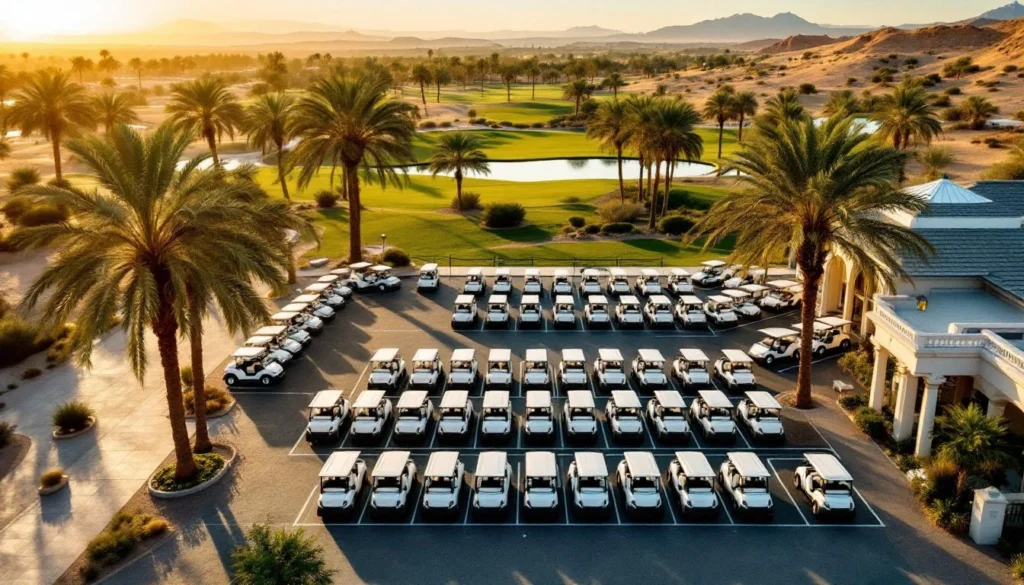
The Middle East luxury golf resort sector has exploded over the past decade, creating demand for specialized fleet management solutions that simply didn’t exist before. The GCC countries now operate 312 golf facilities—a 34% jump since 2018—with total fleet size exceeding 18,500 units, according to the Golf Business Monitor’s 2023 Regional Analysis. These facilities face operational challenges you won’t find anywhere else: ambient temperatures regularly exceeding 45°C (113°F), sand infiltration wreaking havoc on mechanical systems, and premium service expectations requiring 99.2% fleet availability rates. For B2B distributors and fleet managers, understanding the specialized supply chain requirements for this market creates significant competitive advantage and revenue opportunity.
Market Context: Middle East Golf Resort Fleet Management Landscape
The Middle East golf resort market operates under completely different rules than temperate-climate operations. Regional golf courses maintain an average fleet of 59.4 units per 18-hole facility, compared to the global average of 42.3 units, according to the Dubai Sports Council. Longer course distances accommodate desert topography. Higher cart-to-player ratios during peak season (October through April) drive the numbers up.
Investment in golf infrastructure across the GCC keeps accelerating. Saudi Arabia’s Vision 2030 initiative has allocated $1.3 billion specifically for golf tourism development—and the Saudi Golf Federation projects 45 new courses by 2030, each requiring initial fleet procurement of 50-80 units plus comprehensive parts inventory systems. The UAE remains the region’s dominant market. Abu Dhabi and Dubai account for 127 facilities and estimated annual parts and maintenance expenditure of $87 million across the golf sector.
Fleet composition in luxury Middle East resorts skews heavily toward premium electric models. 83% of courses operate lithium-ion equipped fleets according to the Middle East Golf Industry Association’s 2023 Equipment Survey—compared to just 64% globally. The preference for electric drives stems from noise reduction requirements near residential developments, emission-free operation mandates in several emirates, and superior torque characteristics for navigating the steep terrain common in desert course design.

Maintenance cycles in desert climates operate on compressed timelines. Research from the Dubai Golf Industry Consortium shows component replacement frequencies averaging 18-22 months for critical systems versus 30-36 months in temperate climates. Battery systems face particular stress. Thermal management challenges reduce lithium-ion pack lifespan by 26% compared to manufacturer specifications (which assume 25°C baseline operating conditions). This accelerated degradation creates consistent demand for replacement components and presents real inventory planning challenges for distributors serving this market.
Desert Climate Durability Requirements and Component Specifications
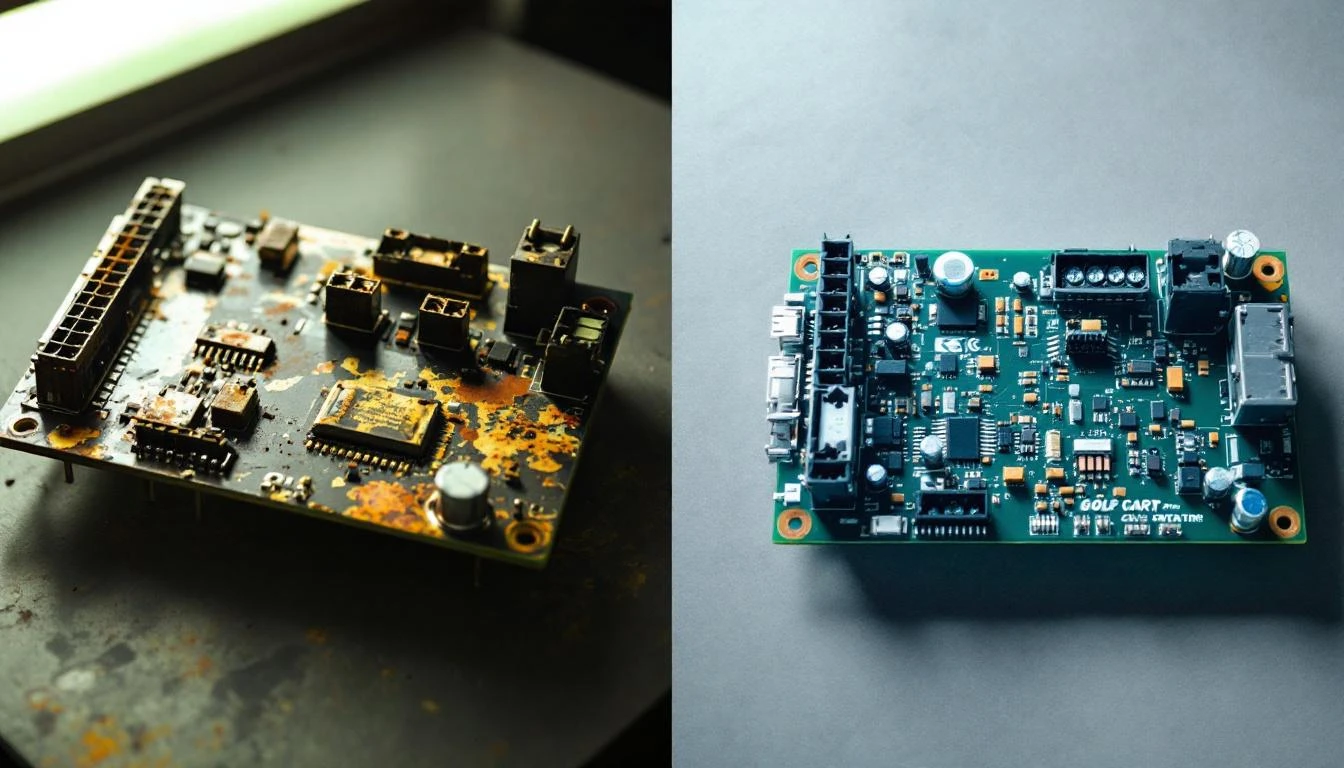
Engineering specifications for Middle East golf resort fleet components require substantial modifications from standard production parts. Temperature resistance represents the primary design consideration—electrical systems need operation certification to 65°C (149°F) ambient temperatures, substantially higher than the 50°C standard for most golf cart electronics. Controller boards must incorporate conformal coating for sand infiltration protection. Connector housings require sealed designs meeting IP65 or higher ingress protection ratings.
Battery technology selection presents complex tradeoffs. While lithium iron phosphate (LiFePO4) chemistry offers superior thermal stability compared to nickel manganese cobalt formulations, the cost premium runs 32-38%. But lifecycle analysis conducted by the Emirates Golf Equipment Research Institute demonstrates that LiFePO4 systems deliver 1,840 charge cycles in desert conditions versus 1,340 cycles for standard lithium-ion packs—providing 23% lower total cost of ownership despite higher acquisition costs.
Tire specifications must address both extreme heat and abrasive sand. Premium resort operations require low-pressure turf tires to minimize course damage, but standard compounds degrade rapidly under sustained contact with 70°C+ surface temperatures common on cart paths during summer months. Distributors serving this market stock specialized high-silica compound tires with heat dissipation ratings to 85°C. These cost 41% more than standard turf tires but deliver 2.3x service life according to field data from major UAE courses.
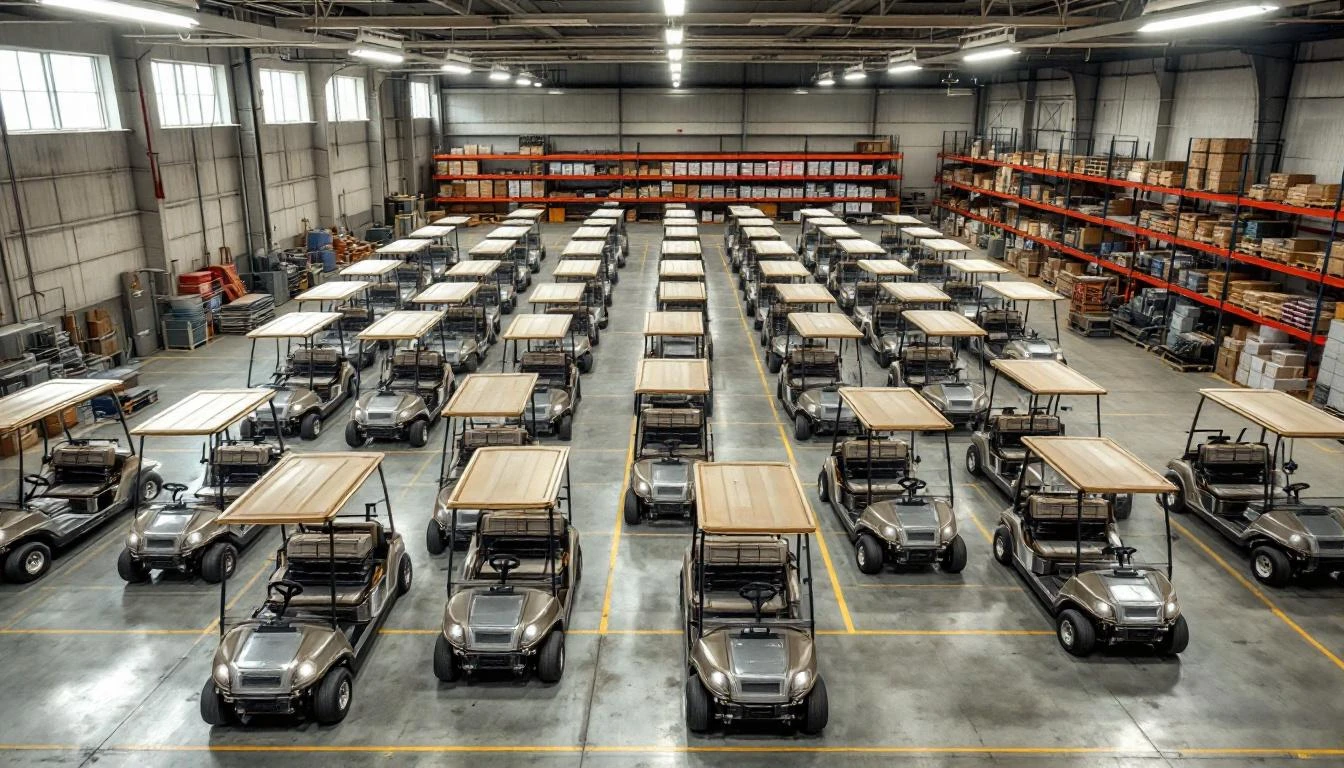
Cooling system components face accelerated wear in sandy environments. Air intake pre-filters require replacement every 180-220 operating hours versus 400-500 hours in temperate climates. Motor cooling fans experience bearing failure at 73% of rated service life due to fine particulate infiltration. Forward-thinking distributors have developed preventive maintenance kits specifically configured for desert operations—bundling high-frequency replacement items at 15-18% cost savings versus individual component ordering while improving inventory turns.
Supply Chain Architecture for Premium Resort Fleet Support
Luxury golf resorts in the Middle East maintain service level agreements requiring maximum 4-hour resolution for fleet availability issues. The six major luxury resort operators—including Emirates Golf Club, Saadiyat Beach Golf Club, and Trump International Golf Club Dubai—collectively enforce 99.2% fleet availability standards in their facility management contracts, with financial penalties averaging $2,400 per day for non-compliance.
This operational environment necessitates local inventory positioning rather than just-in-time procurement models. Analysis of distributor operations across the GCC region indicates optimal inventory investment ranges from $142,000 to $186,000 per serviced facility for distributors maintaining comprehensive parts coverage. This inventory depth supports same-day fulfillment for 94% of service requests while maintaining inventory turns of 4.2-4.8 annually.
Multi-echelon inventory optimization models prove particularly effective for distributors serving multiple facilities. Regional distribution centers positioned in Dubai, Doha, and Riyadh can support spoke inventory locations at individual courses, with automated replenishment systems triggered when local stock falls below 2.1-week coverage based on historical consumption patterns. This architecture reduces total network inventory by 27-31% compared to fully independent facility stocking while maintaining service levels, according to supply chain modeling conducted for major regional distributors.

Vendor-managed inventory (VMI) arrangements have gained traction among larger fleet operators. 38% of courses operating more than 60 units now utilize VMI programs according to the Gulf Golf Fleet Management Study. Under these arrangements, distributors maintain ownership of consigned inventory at customer facilities, improving distributor inventory visibility and reducing customer working capital requirements. VMI programs typically achieve 96-98% fill rates with 22% lower total inventory investment compared to traditional purchase-order models.
Import and customs considerations significantly impact supply chain design. The GCC Customs Union provides duty-free movement between member states, but component classification remains critical—parts classified as “golf cart components” (HS code 8716.80) face 5% duty rates, while items reclassified as “general automotive parts” may incur 15-20% duties. Experienced distributors maintain detailed technical documentation supporting proper classification, avoiding the 12-18 week delays associated with customs reclassification disputes.
Procurement Models and Distributor Positioning Strategies
Market positioning for Middle East golf resort fleet supply requires understanding the distinct procurement philosophies among different facility types. Developer-owned trophy courses prioritize brand alignment and premium positioning, showing 89% preference for OEM-certified components even at 35-45% price premiums over aftermarket alternatives. These facilities view fleet presentation as integral to overall brand experience. One luxury operator described their fleet as “the clubhouse on wheels” in procurement specifications.
Operator-managed facilities and golf communities demonstrate greater price sensitivity while maintaining quality thresholds. These buyers typically specify “OEM-equivalent” components meeting original specifications but accept non-OEM manufacture, creating opportunities for distributors offering certified aftermarket components. This segment represents 61% of the regional market by facility count and shows consistent 8-12% annual growth in aftermarket component adoption.

Annual maintenance contracts represent substantial revenue opportunity—facility spend ranges from $47,000 to $124,000 annually depending on fleet size and service scope. Maintenance agreements including parts, labor, and preventive maintenance scheduling command 23-28% margins for distributors, compared to 15-19% margins on parts-only transactions. But these contracts require sophisticated cost modeling to account for desert climate’s accelerated component consumption and avoid margin erosion.
Strategic sourcing partnerships between distributors and facilities increasingly incorporate performance-based pricing models. Distributors guarantee specific fleet availability metrics (typically 97-99%) with financial penalties for underperformance but earn bonus payments for exceeding targets. Risk-adjusted margins on performance contracts average 3.2 percentage points higher than traditional supply agreements, reflecting the distributor’s assumption of availability risk and incentivizing proactive inventory management.
Technology integration distinguishes leading distributors in this market. Fleet telematics systems now installed on 72% of luxury resort carts generate predictive maintenance data streams. Distributors integrating with these platforms can anticipate component failures 15-21 days in advance, pre-positioning inventory and scheduling maintenance during low-utilization periods. This capability reduces emergency service calls by 64% and improves customer satisfaction scores by 31 points (on a 100-point scale) according to operations data from technology-enabled distributors.
What This Means for Dealers and Distributors
The Middle East luxury golf resort market presents substantial opportunities for B2B distributors prepared to address its unique requirements. With regional golf course development projected to add 68 new facilities by 2028 and existing fleet replacement cycles accelerated by climate factors, annual addressable market for fleet components and maintenance supplies exceeds $203 million and grows at a 7.3% CAGR through 2030.

Market entry requires understanding the distinct customer segments and their procurement behaviors. Trophy courses operated by luxury hospitality groups prioritize relationship-based selling, technical expertise, and rapid response capabilities over price optimization. Building technical credibility through manufacturer certifications, employing staff with OEM training credentials, and maintaining deep local inventory establishes competitive positioning with this segment. These buyers conduct supplier evaluations on 18-24 month cycles. High switching costs once relationships are established provide revenue stability for qualified distributors.
The golf community and semi-private facility segment offers higher volume potential with different success factors. These operators increasingly professionalize fleet management, hiring dedicated equipment managers with technical backgrounds rather than relying on course superintendents for procurement decisions. Effective distributors serving this segment provide data-driven total cost of ownership analyses, demonstrate lifecycle cost advantages of premium components in desert climates, and offer flexible payment terms aligned with seasonal cash flow patterns.
Geographic positioning creates natural competitive advantages. Distributors with established presence in Dubai or Riyadh can efficiently serve surrounding markets through hub-and-spoke distribution models. But significant opportunities exist in emerging markets—Oman’s tourism development program targets 25 new courses by 2027, while Egypt’s Red Sea developments incorporate 18 planned golf facilities. Early market entry in these geographies allows relationship establishment before competition intensifies, though it requires higher risk tolerance given infrastructure and payment term considerations.
Diversification into complementary product categories enhances distributor value proposition and wallet share. Beyond core powertrain and chassis components, luxury courses require specialty items including GPS systems, premium seating, custom bodywork, and charging infrastructure. Full-service distributors offering solutions across categories report 34% higher revenue per customer and 41% better retention rates compared to parts-only suppliers, according to distributor performance benchmarking data.
How to Take Action: Implementation Roadmap
Distributors seeking to establish or expand Middle East golf resort fleet management supply capabilities should follow a structured market entry approach. Initial assessment should quantify serviceable obtainable market within realistic service radius—typically 200km for same-day delivery commitments. Survey existing golf facilities to document fleet sizes, current supplier relationships, contract renewal timing, and satisfaction with incumbent suppliers. This intelligence gathering typically requires 60-90 days and provides foundation for targeted business development.
Inventory planning represents the critical second phase. Analyze fleet composition across target facilities to determine component commonality and prioritize stocking depth accordingly. The Pareto principle applies strongly here—approximately 23% of SKUs account for 78% of service demand. Initial inventory investment should focus on this high-velocity segment while establishing expedited supply relationships for slower-moving specialty components. Working capital requirements for market entry typically range from $380,000 to $520,000 including inventory, warehouse infrastructure, and service vehicle investment.
Certification and technical credibility building should occur parallel to inventory development. Pursue manufacturer certification programs for dominant fleet brands in your target market—Club Car and E-Z-GO maintain leading positions in the Middle East luxury segment. Certification programs require 40-80 hours of technical training and $8,000-$15,000 investment but provide access to technical support resources, warranty programs, and competitive advantages in OEM parts procurement pricing. Many luxury facilities maintain policies requiring certified technician involvement for warranty-covered service work.
Technology infrastructure increasingly differentiates competitive distributors. Implement inventory management systems with real-time stock visibility, automated reorder point calculation, and customer portal access for order placement and service request submission. Integration capabilities with fleet telematics platforms allow proactive service scheduling and predictive parts positioning. Cloud-based systems suitable for mid-market distributors require $18,000-$35,000 implementation investment plus ongoing subscription costs but typically achieve ROI within 14-18 months through inventory optimization and service efficiency gains.

Customer acquisition should employ account-based marketing approaches given the concentrated nature of the luxury resort market. Develop facility-specific value propositions demonstrating understanding of each operation’s unique requirements, current pain points, and improvement opportunities. Technical white papers addressing desert climate durability challenges, lifecycle cost analyses, and case studies from similar facilities establish credibility. Direct engagement with equipment managers and course superintendents at industry events—including the annual Middle East Golf Show and regional Golf Course Superintendents Association conferences—provides relationship-building opportunities.
For established distributors seeking to optimize existing Middle East operations, operational review should focus on inventory health metrics, supplier performance, and customer profitability analysis. Identify slow-moving inventory for rationalization—SKUs with less than 2 turns annually typically merit discontinuation unless supporting strategic accounts. Evaluate supplier performance across quality, delivery reliability, and pricing competitiveness. Customer profitability analysis frequently reveals that 30-40% of accounts generate minimal contribution after fully-loaded service costs, indicating opportunities for minimum order policies or service fee implementation.
Partnering with established suppliers offering extensive product portfolios, technical support, and favorable commercial terms accelerates market development. TGCP provides wholesale distributors with access to premium golf cart components specifically engineered for demanding operational environments, technical resources including installation guides and troubleshooting documentation, and flexible order quantities supporting efficient inventory management. Our distributor program includes dedicated account management, co-marketing support, and technical training resources. For detailed information on distribution partnership opportunities and wholesale pricing structures, request a consultation with our B2B sales team to discuss your specific market requirements and business objectives.
Frequently Asked Questions
What inventory investment is required to effectively serve Middle East luxury golf resort accounts?
Comprehensive parts coverage for a single luxury golf facility operating 50-70 carts typically requires $142,000-$186,000 in inventory investment across powertrain components, chassis parts, electrical systems, and consumables. This investment level supports same-day fulfillment for 94% of service requests while maintaining healthy inventory turns of 4.2-4.8 annually. Distributors serving multiple facilities can optimize total network inventory through hub-and-spoke distribution models, reducing per-facility investment by 27-31% while maintaining service levels. Initial market entry serving 3-5 facilities typically requires $380,000-$520,000 total working capital including inventory, warehousing infrastructure, and service equipment. Multi-echelon inventory optimization and vendor-managed inventory programs offer opportunities to improve capital efficiency as operations scale.

How do desert climate conditions affect component lifecycle and replacement frequencies?
Desert climate operations significantly compress component lifecycles compared to temperate environments. Research from the Dubai Golf Industry Consortium indicates average replacement frequencies of 18-22 months for critical systems versus 30-36 months in moderate climates, representing approximately 40% acceleration. Battery systems experience particularly acute stress, with lithium-ion pack lifespan reduced by 26% due to thermal management challenges in sustained high-temperature operation. Air filtration components require replacement every 180-220 operating hours versus 400-500 hours in low-dust environments. Motor cooling fan bearings fail at 73% of rated service life due to particulate infiltration. These accelerated consumption patterns create consistent replacement demand but require sophisticated inventory planning and customer education regarding total cost of ownership rather than initial acquisition cost alone.
What certifications and technical capabilities are necessary for serving luxury resort accounts?
Luxury golf resort accounts typically require distributor technical capabilities significantly exceeding basic parts supply. Manufacturer certification from dominant fleet brands (Club Car, E-Z-GO, Yamaha) provides essential credibility and access to technical resources, warranty programs, and competitive parts pricing. Certification programs require 40-80 hours of technical training and $8,000-$15,000 investment but many luxury facilities mandate certified technician involvement for warranty service work. Beyond certifications, technical staff should possess diagnostic capabilities for lithium-ion battery management systems, controller programming expertise, and understanding of fleet telematics platforms. Many leading distributors employ staff with automotive electrical backgrounds or golf course equipment experience. Facilities increasingly expect consultative support including lifecycle cost analysis, preventive maintenance program design, and fleet optimization recommendations rather than purely transactional parts supply relationships.
How do procurement models differ between developer-owned trophy courses and operator-managed facilities?
Procurement philosophies vary substantially across facility types in the Middle East market. Developer-owned trophy courses associated with luxury resort properties prioritize brand alignment and premium positioning, demonstrating 89% preference for OEM-certified components despite 35-45% price premiums over aftermarket alternatives. These facilities view fleet presentation as integral to overall brand experience and conduct supplier evaluation on relationship quality, technical expertise, and response capabilities rather than price optimization. Conversely, operator-managed facilities and golf communities show greater price sensitivity while maintaining quality thresholds, with 61% of this segment accepting “OEM-equivalent” components meeting original specifications but allowing non-OEM manufacture. This segment responds to data-driven total cost of ownership presentations and values flexible payment terms aligned with seasonal cash flow. Understanding these distinct buying behaviors allows distributors to develop appropriately differentiated value propositions and commercial terms.
What role does technology integration play in competitive differentiation for Middle East distributors?
Technology capabilities increasingly separate market leaders from commodity suppliers in the Middle East luxury golf resort segment. Fleet telematics systems now installed on 72% of luxury resort carts generate predictive maintenance data streams that forward-thinking distributors use for competitive advantage. Integration with these platforms enables anticipation of component failures 15-21 days in advance, allowing proactive parts positioning and maintenance scheduling during low-utilization periods. This capability reduces emergency service calls by 64% and improves customer satisfaction scores by 31 points on 100-point scales. Customer-facing technology including inventory management portals with real-time stock visibility, online ordering systems, and mobile service request applications enhance distributor convenience and operational efficiency. Cloud-based systems require $18,000-$35,000 implementation investment but typically achieve ROI within 14-18 months through inventory optimization, improved service efficiency, and enhanced customer retention. Technology adoption represents a significant competitive moat as luxury facilities increasingly expect digital integration from suppliers.